Cecelia Blyghton
Allen’s mother, recorded with him in the 1841 Nottingham census.
A boy in the record. A life beyond the sentence.
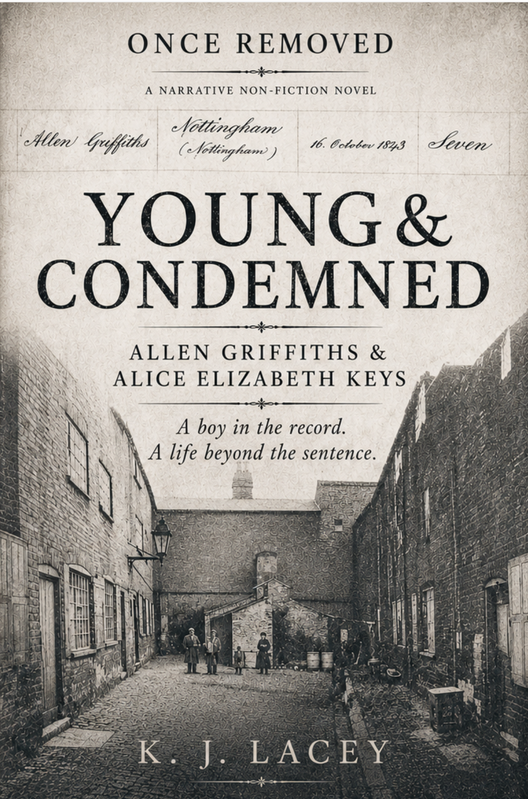
Allen was a child when a Nottingham court sentenced him to seven years’ transportation for stealing potted beef. The records follow him through Millbank, Parkhurst and Port Phillip. The novel follows the life that sentence could not contain.
This companion makes the underlying record visible. It offers a source list and individual profiles of people who appear in the story. Dates and sources are given where the records support them; the novel’s private scenes remain imaginative reconstruction.
Find the book on Amazon AustraliaThese people were real. The novel reconstructs some of their interactions; the records do not preserve every conversation or motive.
Allen’s mother, recorded with him in the 1841 Nottingham census.
Convicted alongside Allen in the 1843 potted beef theft.
A Nottingham boy connected to Allen’s earlier larceny case.
Allen’s younger sister, living with him in 1841; her later life is uncertain.
Allen’s father, known chiefly through marriage and family records.
Sentenced with Allen, then transported to Van Diemen’s Land.
Convicted of receiving stolen goods in a case where Allen gave evidence.
Records and publications used to reconstruct Allen Griffiths’s life and family, grouped by source type. The citations are listed without a timeline of the novel’s events.
“The record tells me what happened. The novel asks what it meant.”
The documents establish dates, places, proceedings and family relationships, sometimes imperfectly. Dialogue, private thoughts and connecting scenes are reconstructed. Where sources disagree, the uncertainty belongs in the story of the research too.
Read the FAQ